

Google’s push toward AI‑generated answers is reshaping the web in ways that could leave publishers struggling and users less satisfied, according to a new research paper, AI in Search Reduces Publisher Referrals Without Improving User Experience: Experimental Evidence.
Conducted with 1,100 U.S. participants over 10 days, the study tested three versions of Google Search:
- The standard experience
- A version with AI Overviews removed
- Conversational “AI Mode” that routed every query through Gemini.
The results show that AI search is already altering online behavior, and it’s not generally good news for users, publishers, or Google.
Traffic Falls When AI Answers Replace Links
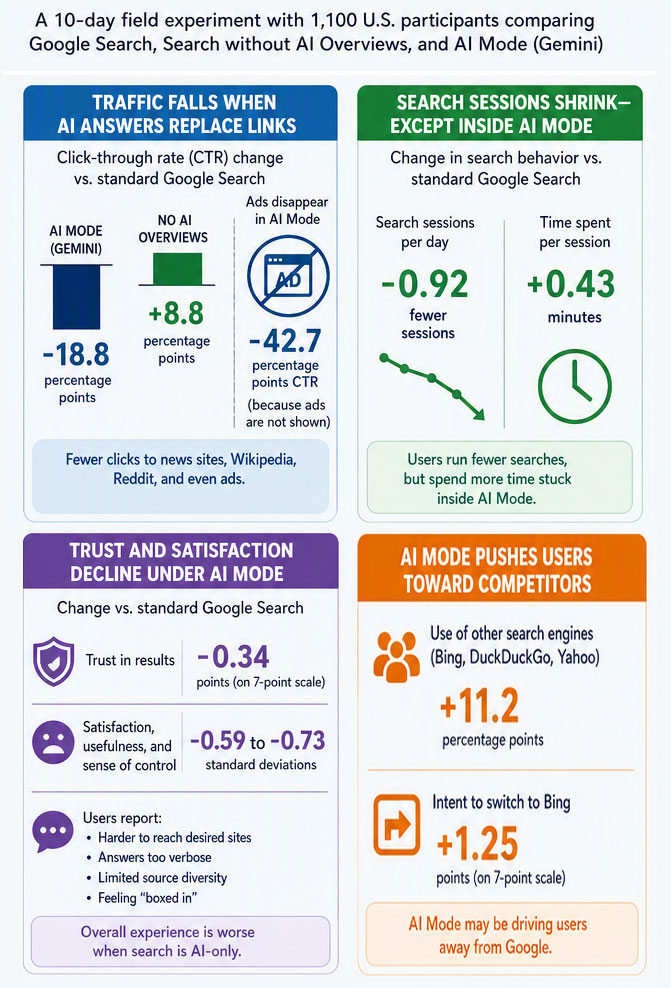
The most immediate impact was on publisher referrals. When participants were forced into AI Mode, click‑through rates to external sites collapsed by 18.8 percentage points. Users clicked less on news outlets, Wikipedia, Reddit, and ads (note: no ads show in the AI search section).
Removing AI Overviews had the opposite effect: click‑through rose 8.8 points, offering experimental confirmation of what publishers have been reporting for months.
In a preregistered randomized field experiment on Google Search, routing users to Google’s AI Mode substantially reduced click-throughs to external publishers and lowered trust/satisfaction, while hiding AI Overviews modestly increased publisher click-throughs but did not improve user perceptions. — The Commonplace
Search Sessions Shrink (Except Inside AI Mode)
Google has argued that AI features increase search engagement. The study found the opposite. Participants in AI Mode performed 0.92 fewer search sessions per day. Heavy Google users saw an even steeper drop.
Yet paradoxically, they spent more time per session (an extra 0.43 minutes). The researchers interpret this as users getting “stuck” inside AI Mode: fewer searches, fewer clicks, but longer time spent with AI‑generated answers.
Trust and Satisfaction Decline Under AI Mode
The study also measured how people felt about the information they received. Trust in Google’s results fell by 0.34 points on a 7‑point scale. Satisfaction, usefulness, and sense of control all dropped sharply between 0.59 and 0.73 standard deviations.

Participants frequently described feeling boxed in by AI Mode. Many said it was harder to reach the websites they wanted, that answers were too verbose, or that source diversity was limited.
AI Mode Pushes Users Toward Competitors
One of the most striking findings: AI Mode made people more likely to abandon Google entirely. Use of Bing, DuckDuckGo, or Yahoo rose 11.2 percentage points, and intent to switch to Bing jumped by 1.25 points on a 7‑point scale.

The researchers warn that Google’s strategy of pushing AI Mode could backfire if users continue to dislike the experience.
A Growing Tension for the Future of Search
The study’s authors argue that Google is shifting from being an intermediary — a gateway to the web — to being a destination that answers questions directly. That shift may have regulatory implications as well. A recent German ruling found that AI Overviews make Google a content provider rather than a neutral search engine. That follows on the heels of EU AI Act Article 50, which requires new transparency rules for AI content.
The economic implications are equally significant. If AI Mode becomes the default, publishers could see sustained declines in traffic, threatening ad‑supported business models. And users, at least for now, aren’t getting a better experience in return.
The finding that click quality did not differ between groups is particularly relevant to any advertiser or publisher currently deciding whether to treat AI Overview-adjacent traffic as a strategic asset or as a shrinking pool of visits worth defending. — Luis Rijo, PPC Land
The experiment also confirms what the digital media industry has already seen in referral data: links within AI Overviews do little to offset the reduction in outbound traffic. Among outbound clicks on search pages where an AIO appears, only 7.1% come from links within the AI-generated answer. The remaining 92.9% come from traditional organic results on the same search page.
The experiment also confirms what the digital media industry has already seen in referral data: links within AI Overviews do little to offset the reduction in outbound traffic. Among outbound clicks on search pages where an AIO appears, only 7.1% come from links within the AI-generated answer. The remaining 92.9% come from traditional organic results on the same search page. — Rande Price, Research VP, DCN
The Bottom Line
This experiment offers some of the clearest causal evidence to date about AI’s impact on search. The takeaway is blunt. In this study, AI Mode reduces traffic to the broader web, erodes trust, and worsens user experience while nudging people toward competing search engines.
Is Google Lying About AI Mode? Google, from Liz Reid to CEO Sundar Pichai consistently say that users are delighted with Google AI Mode, that they engage with it strongly, and that they prefer it. The evidence from this study, AI in Search Reduces Publisher Referrals Without Improving User Experience: Experimental Evidence, strongly suggests that the opposite is true, that the user experience is notably worse with AI Mode. — Roger Montti, Search Engine Journal
As Google continues to roll out AI‑driven search, the study suggests a fundamental question is emerging: Who benefits when AI answers replace the open web?

