

Google’s March 2024 core algorithm update is cracking down on low-quality, AI-generated content across the web. Google wants to “reduce unhelpful, unoriginal content on Search and keep it at very low levels.”
Google says the update involves adjusting its rankings “if webpages are unhelpful, have a poor user experience. or feel like they were created for search engines instead of people.”
For websites that have relied on AI tools to generate content — but without a human touch of editing, insight, and original thought — this algorithm update presents some challenges.
Pure AI-written content is clearly being targeted, as Google notes they will “take action on more types of content with little to no value created at scale, like pages that pretend to have answers to popular searches but fail to deliver helpful content.”
Did Google Do Website Owners a Dis-service?
Google had originally said AI content was OK – IF it produced quality content that provided value. Many website owners interpreted that as a green light for using AI and added massive amounts of content to their sites.
Uh, oh.
They forget about the VALUE part of the equation.
The content generated wasn’t helpful, educational, or informative beyond what was already online.
Look, AI is a great tool to pull together thoughts, but it often just rephrases existing content in a new way. This doesn’t provide any additional value.
That’s really bad news for sites that didn’t create relevant, insightful content that aligned with Google’s E-E-A-T guidelines.
Websites that fail to incorporate substantial human expertise and simply publish lightly edited AI output could see a major hit to their search rankings and traffic.
Google’s taken manual actions against a large number of sites – many got tagged as spam or low-quality content.
Entire sites have been de-indexed and no longer appear in search results.
My Unscientific Test: AI vs Humans
I launched two sites at the same time last year. One has 100% human-written content and the other has 100% AI-written content on the same topic.
Yes, the human content regularly outperformed the AI content as far as traffic, dwell time, bounce rates, and overall engagement. Visitors also tended to click more often on related content on the human site. The AI site had a much slower build when first launched, but the bottom fell out after the latest update. While there has not been a manual action initiated by the Google team, content from the site now only shows up in search if you search specifically for the site or the article title.
Here’s the side-by-side comparison.
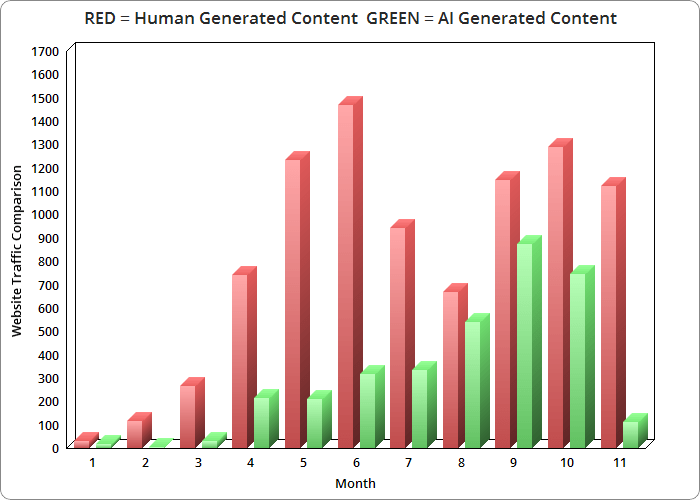
While not exactly a controlled study, it does show how Google is now downgrading AI-written content that does not provide value. I plan to keep this experiment going to see what happens six months from now.
A Path Forward?
I’m not anti-AI. Far from it. I went and got certified as an AI writer and AI prompt engineer. I have several clients who have me create AI content and then go and rework it to provide the missing SEO and value creation.
When you think of AI as a tool instead of a total solution, you can do some amazing things. Summarize content to help with understanding. Creating charts from text and data sources. Helping you see what’s missing in your workflow. Coding basic information. Just don’t count on it for deep insight or math.
Search Engine Journal outlines that there is still a path for websites to utilize AI writing assistance, as long as significant human expertise, experience, and originality are incorporated. Yup, that’s exactly on point.
From the article:
“What matters most about content is the insight behind the content, not who or what wrote it. A way forward may be to use a mix of human insight and experience as data that the AI can use for generating content.”
Search Engine Journal
Google echoes this notion in their announcement, saying their policy is against “producing content at scale to boost search ranking — whether automation, humans or a combination are involved.” The key is ensuring the content provides true value and originality.
Google directly states they will take action against “very low-value, third-party content produced primarily for ranking purposes and without close oversight of a website owner.” This suggests that websites utilizing AI assistance need to have extremely tight oversight and editing to add authentic value.
Importantly, Google expects this update will collectively reduce low-quality, unoriginal content in search results by 40%.
If you invested too heavily in AI writing as the solution, you are at serious risk. My suggestion: wipe it clean and rebuild your content using people not machines.
 Paul Dughi.com