
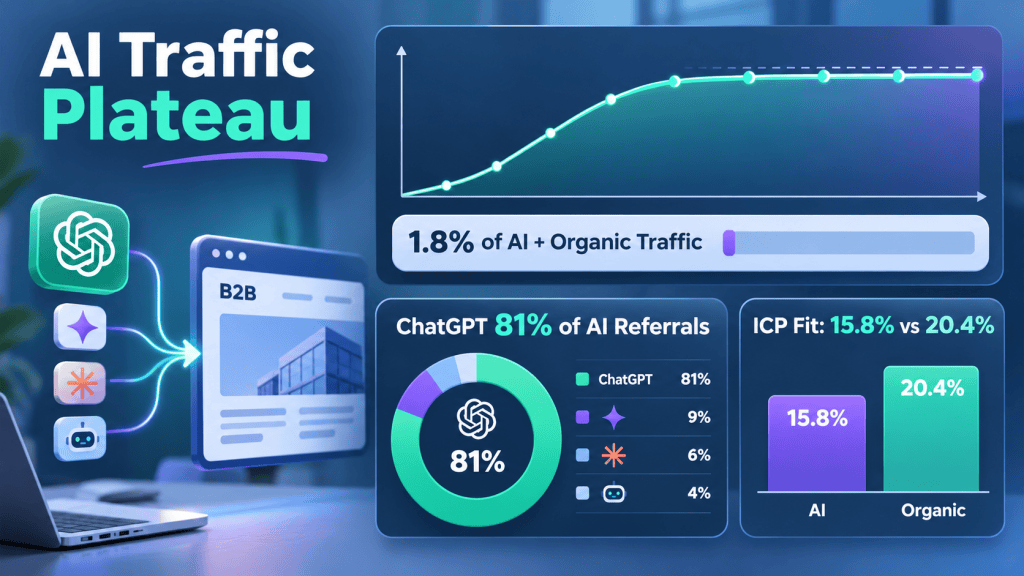
A new study from Leadfeeder finds that while AI assistants are becoming a visible source of website referrals, they remain a relatively small contributor to overall B2B website traffic. The research examined referral behavior across 1,200 B2B websites and assessed not only how much traffic AI tools generate, but also whether that traffic comes from companies that match a business’s ideal customer profile (ICP).
While there’s a lot of focus in SEO circles about optimizing for AI, AI-generated referrals account for just 1.8% of combined AI and organic search visits.
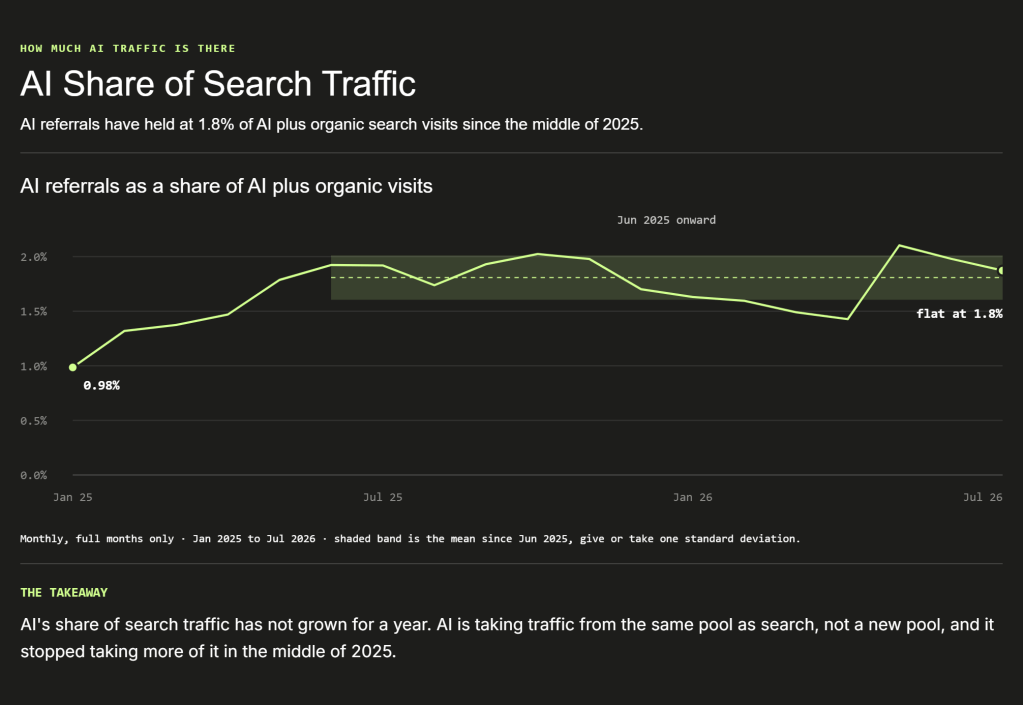
SOURCE: Leadfeeder
AI referral traffic grew rapidly between January 2025 and July 2026, its share of search traffic has remained largely unchanged since mid-2025, suggesting the channel’s explosive early growth has cooled.
ChatGPT is the Leader in AI Referrals
Not all AI platforms contribute equally. Leadfeeder found that OpenAI’s ChatGPT is by far the largest driver of AI referral traffic, accounting for 81% of all AI-referred visits. Google’s Gemini generated 8%, Anthropic’s Claude 5%, Perplexity 3%, and Microsoft Copilot 2%. The remaining AI assistants contributed only a fraction of overall referral volume.
This concentration means ChatGPT largely determines overall AI referral performance and quality metrics across the market. Still, all of the AI referrals together only add up to 1.8 of referrals.
Quality Lags Behind Organic Search
Leadfeeder’s research focused heavily on ICP fit, measuring whether referred companies matched the target customer profiles defined by each website owner.
The study found that 15.8% of companies arriving through AI referrals matched a site’s ICP, compared with 20.4% from organic search and 19.1% from paid search. Even after accounting for geographic differences among visitors, AI traffic still trailed organic search in customer-fit quality.
That said, performance varied by platform. Among the major AI assistants, ChatGPT produced the lowest ICP fit rate at 16.3%, while Copilot and Claude performed strongest at roughly 21.0% and 20.8%, respectively. Excluding ChatGPT, the remaining AI assistants delivered ICP-fit rates close to those of paid search.
Engagement Remains a Challenge
The research also examined whether AI-referred visitors return to websites after their initial visit. Here, AI traffic underperformed other acquisition channels.
Companies referred by AI assistants visited websites an average of 2.68 times, compared with 3.78 visits from organic search users and 5.52 visits from email-driven visitors. In other words, AI channels currently generate less sustained engagement than more established marketing channels.
Key Results
- AI referrals account for 1.8% of combined AI and organic search traffic, a figure that has remained largely flat since mid-2025.
- AI referral traffic grew 3.1x between January 2025 and July 2026.
- ChatGPT generates 81% of all AI referral visits.
- 15.8% of AI-referred companies match a site’s ideal customer profile, versus 20.4% for organic search.
- AI referrals contribute just 1.4% of all ICP-matching companies acquired through measured acquisition channels.
- 32% of sites see AI traffic perform as well as or better than organic search in terms of ICP fit.
- AI-referred companies average 2.68 visits, compared with 3.78 from organic search visitors.
What It Means for Marketers
While AI assistants are undeniably becoming a new source of referral traffic, they are not yet reshaping B2B demand generation. AI traffic remains relatively small, and the companies it sends do not consistently match the quality of those arriving through organic search. However, some AI platforms are approaching paid-search levels of customer fit, suggesting the channel is worth monitoring as adoption and referral patterns continue to evolve.

